

How To Draw Lewis Structures For Transition Metals
Lewis Structures
Writing Lewis Structures by Trial and Error
The Lewis construction of a chemical compound tin can be generated by trial and mistake. We start by writing symbols that contain the correct number of valence electrons for the atoms in the molecule. We then combine electrons to grade covalent bonds until we come up up with a Lewis structure in which all of the elements (with the exception of the hydrogen atoms) have an octet of valence electrons.
Example: Let's use the trial and error arroyo to generating the Lewis structure of carbon dioxide, CO2. We beginning by determining the number of valence electrons on each cantlet from the electron configurations of the elements. Carbon has four valence electrons, and oxygen has six.
C: [He] 2south ii twop two
O: [He] twosouth 2 twop 4
We can symbolize this information as shown at the acme of the figure below. We now combine one electron from each atom to form covalent bonds between the atoms. When this is done, each oxygen atom has a total of seven valence electrons and the carbon atom has a total of vi valence electrons. Because none of these atoms take an octet of valence electrons, nosotros combine some other electron on each cantlet to form two more bonds. The result is a Lewis structure in which each atom has an octet of valence electrons.
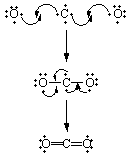

A Step-By-Step Arroyo To Writing Lewis Structures
The trial-and-error method for writing Lewis structures tin can exist time consuming. For all only the simplest molecules, the post-obit pace-by-pace procedure is faster.
Step i: Determine the total number of valence electrons.
Footstep ii: Write the skeleton construction of the molecule.
Pace three: Use two valence electrons to course each bond in the skeleton construction.
Step 4: Endeavor to satisfy the octets of the atoms by distributing the remaining valence electrons as nonbonding electrons.
The first step in this process involves computing the number of valence electrons in the molecule or ion. For a neutral molecule this is cypher more than the sum of the valence electrons on each atom. If the molecule carries an electric accuse, we add one electron for each negative charge or decrease an electron for each positive charge.
Instance: Permit's determine the number of valence electrons in the chlorate (ClO3 -) ion.
A chlorine cantlet (Group VIIA) has 7 valence electrons and each oxygen atom (Group VIA) has six valence electrons. Because the chlorate ion has a charge of -1, this ion contains i more electron than a neutral ClO3 molecule. Thus, the ClO3 - ion has a total of 26 valence electrons.
ClO3 -: seven + 3(6) + 1 = 26
The second stride in this process involves deciding which atoms in the molecule are connected by covalent bonds. The formula of the compound often provides a hint as to the skeleton construction. The formula for the chlorate ion, for instance, suggests the following skeleton construction.

The tertiary step assumes that the skeleton structure of the molecule is held together by covalent bonds. The valence electrons are therefore divided into 2 categories: bonding electrons and nonbonding electrons. Because it takes ii electrons to class a covalent bond, nosotros can calculate the number of nonbonding electrons in the molecule by subtracting two electrons from the total number of valence electrons for each bond in the skeleton structure.
There are 3 covalent bonds in the nearly reasonable skeleton structure for the chlorate ion. As a consequence, half-dozen of the 26 valence electrons must be used every bit bonding electrons. This leaves 20 nonbonding electrons in the valence crush.
| 26 valence electrons |
| - 6 bonding electrons |
| ������������������� |
| 20 nonbonding electrons |
The nonbonding valence electrons are at present used to satisfy the octets of the atoms in the molecule. Each oxygen atom in the ClO3 - ion already has two electrons  the electrons in the Cl-O covalent bail. Because each oxygen atom needs six nonbonding electrons to satisfy its octet, it takes 18 nonbonding electrons to satisfy the iii oxygen atoms. This leaves ane pair of nonbonding electrons, which can exist used to make full the octet of the primal cantlet.

Drawing Skeleton Structures
The near difficult part of the four-footstep process in the previous section is writing the skeleton structure of the molecule. As a general rule, the less electronegative element is at the center of the molecule.
Example: The formulas of thionyl chloride (SOCl2) and sulfuryl chloride (And so2Clii) can be translated into the following skeleton structures.
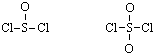
Information technology is also useful to recognize that the formulas for complex molecules are often written in a way that hints at the skeleton structure of the molecule.
Example: Dimethyl ether is frequently written equally CHthreeOCHthree, which translates into the post-obit skeleton structure.

Finally, it is useful to recognize that many compounds that are acids incorporate O-H bonds.
Example: The formula of acetic acid is frequently written as CHthreeCO2H, because this molecule contains the post-obit skeleton structure.

Molecules that Incorporate Too Many or Not Enough Electrons
Besides Few Electrons
Occasionally we see a molecule that doesn't seem to have enough valence electrons. If we can't get a satisfactory Lewis structure by sharing a single pair of electrons, it may be possible to reach this goal past sharing ii or even three pairs of electrons.
Example: Consider formaldehyde (HiiCO) which contains 12 valence electrons.
HtwoCO: two(1) + iv + 6 = 12
The formula of this molecule suggests the following skeleton structure.

In that location are three covalent bonds in this skeleton construction, which means that vi valence electrons must be used as bonding electrons. This leaves vi nonbonding electrons. It is impossible, however, to satisfy the octets of the atoms in this molecule with simply 6 nonbonding electrons. When the nonbonding electrons are used to satisfy the octet of the oxygen atom, the carbon atom has a total of only six valence electrons.
Nosotros therefore assume that the carbon and oxygen atoms share ii pairs of electrons. There are now four bonds in the skeleton structure, which leaves just iv nonbonding electrons. This is plenty, however, to satisfy the octets of the carbon and oxygen atoms.

Every once in a while, we run into a molecule for which information technology is impossible to write a satisfactory Lewis construction.
Example: Consider boron trifluoride (BF3) which contains 24 valence electrons.
BF3: 3 + 3(7) = 24
There are 3 covalent bonds in the most reasonable skeleton structure for the molecule. Because it takes six electrons to form the skeleton structure, in that location are xviii nonbonding valence electrons. Each fluorine atom needs half dozen nonbonding electrons to satisfy its octet. Thus, all of the nonbonding electrons are consumed by the three fluorine atoms. As a outcome, we run out of electrons while the boron atom has only half dozen valence electrons.

The elements that grade potent double or triple bonds are C, Due north, O, P, and South. Because neither boron nor fluorine falls in this category, we have to terminate with what appears to be an unsatisfactory Lewis structure.
Besides Many Electrons
It is also possible to encounter a molecule that seems to have as well many valence electrons. When that happens, nosotros expand the valence shell of the central cantlet.
Example: Consider the Lewis construction for sulfur tetrafluoride (SF4) which contains 34 valence electrons.
SFiv: 6 + 4(7) = 34
There are four covalent bonds in the skeleton structure for SFiv. Because this requires using eight valence electrons to form the covalent bonds that hold the molecule together, there are 26 nonbonding valence electrons.
Each fluorine cantlet needs 6 nonbonding electrons to satisfy its octet. Because at that place are four of these atoms, and so we need 24 nonbonding electrons for this purpose. Only there are 26 nonbonding electrons in this molecule. We accept already satisfied the octets for all five atoms, and we nevertheless have i more pair of valence electrons. Nosotros therefore expand the valence shell of the sulfur atom to hold more 8 electrons.

This raises an interesting question: How does the sulfur atom in SFfour hold 10 electrons in its valence crush? The electron configuration for a neutral sulfur atom seems to suggest that it takes eight electrons to fill the 3s and 3p orbitals in the valence shell of this atom. But permit's wait, in one case once more, at the selection rules for atomic orbitals. Co-ordinate to these rules, the n = 3 shell of orbitals contains 3south, 3p, and 3d orbitals. Because the 3d orbitals on a neutral sulfur cantlet are all empty, 1 of these orbitals tin can be used to concur the extra pair of electrons on the sulfur atom in SFfour.
S: [Ne] 3s 2 3p iv threed 0
Resonance Hybrids
2 Lewis structures can be written for sulfur dioxide.
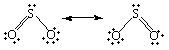
The only difference between these Lewis structures is the identity of the oxygen atom to which the double bond is formed. As a event, they must exist every bit satisfactory representations of the molecule.
Interestingly plenty, neither of these structures is right. The two Lewis structures propose that one of the sulfur-oxygen bonds is stronger than the other. There is no difference betwixt the length of the two bonds in SOii, however, which suggests that the two sulfur-oxygen bonds are equally potent.
When we can write more ane satisfactory Lewis structure, the molecule is an average, or resonance hybrid, of these structures. The meaning of the term resonance can exist best understood by an analogy. In music, the notes in a chord are often said to resonate they mix to give something that is more than the sum of its parts. In a similar sense, the ii Lewis structures for the SO2 molecule are in resonance. They mix to give a hybrid that is more than than the sum of its components. The fact that SOtwo is a resonance hybrid of two Lewis structures is indicated by writing a double-headed arrow between these Lewis structures, as shown in the figure above.
Formal Charge
Information technology is sometimes useful to calculate the formal charge on each cantlet in a Lewis structure. The first step in this calculation involves dividing the electrons in each covalent bond between the atoms that form the bond. The number of valence electrons formally assigned to each atom is then compared with the number of valence electrons on a neutral atom of the element. If the atom has more than valence electrons than a neutral atom, information technology is assumed to carry a formal negative charge. If information technology has fewer valence electrons it is assigned a formal positive charge.
The formula of the amino acid known as glycine is oft written as H3N+CH2CO2 -. Use the concept of formal charge to explain the meaning of the positive and negative signs in the following Lewis structure.
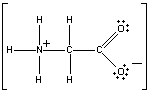
Click here to bank check your answer to Do Trouble 5


Source: https://chemed.chem.purdue.edu/genchem/topicreview/bp/ch8/lewis.html
Posted by: hawkinsgail2001.blogspot.com
0 Response to "How To Draw Lewis Structures For Transition Metals"
Post a Comment