

How To Draw An Architectural Building
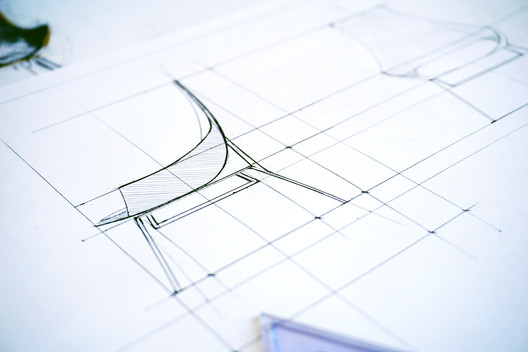
The black sheep of all architectural drawing has got to be technical drawing. Everybody loves drawing perspectives, sketches —yous know the creative, interesting and expressive function of architectural drawing. But what about the aspects of drawing: the technical, logical, rational role? Information technology might not be as sexy as freehand drawing, but it is but equally important.
If you don't know proper technical drawing skills information technology will show in your work; your perspectives will look 'less smart' and badly proportioned and your designs will lack consistency. Then in club to make technical drawings look less cold and more than approachable, I'one thousand sharing the best 20 technical drawing tips I've come across.

These technical drawing tips might destroy your preconceived notions regarding technical drawing, simply they will aid y'all befriend the beast (and also geta lot better at drawing axonometrics, sections, plans, and even descriptive geometry). So sit dorsum, relax, and go a pen and paper to have notes.
.jpg?1519147130)
i. Start seeing technical drawing as of import equally freehand cartoon.
The natural tendency is to completely ignore technical drawing. I suggest that you see it for what information technology is and start allocating several hours per week to getting amend at it! When you get better at technical work, you will ameliorate your overall drawing and blueprint skills.
2. Always clean your triangles and drawing board to go on the smudging to a minimum.
A big no-no for achieving great technical drawings is smudging the sheet and making your drawings look messy and clumsy. Y'all can easily avert this by always cleaning your triangles.
3. Cover your triangles in paper scotch tape – that is going to reduce smudging besides.
Paper scotch tape will remove most crud from your cartoon sail; but remember to modify it from time to time. This technique works very well with tip #2.
four. Construct your technical drawings using an HB pencil.
HB gives enough clarity while keeping smudging to a minimum. Use that to your reward! Yous tin can harden the construction lines later using a softer pencil (2B+).

v. See the virtue in patience. Don't lose your cool when faced with challenging technical drawings.
Technical drawing is famous (or infamous) for existence a brain twister. Have this upfront—trust me, that's going to save you a lot of hassle and heartache later. Yous'll have to do this for a while until yous become used to it.
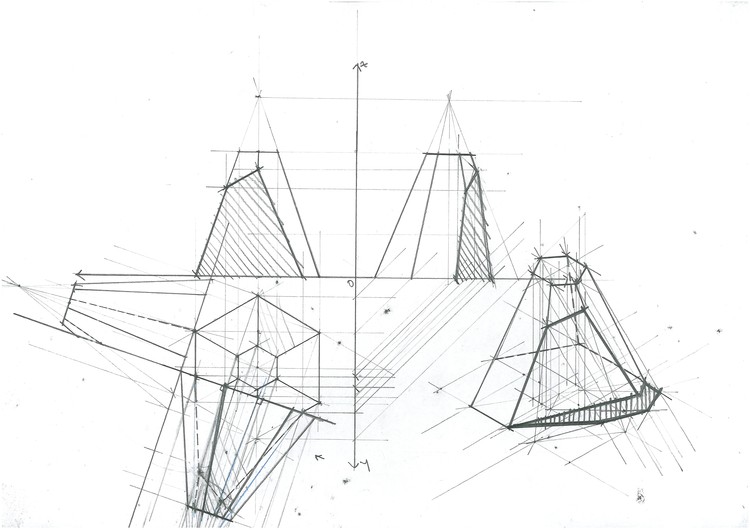
6. Start seeing the beauty in descriptive geometry… and exercise descriptive geometry each and every solar day.
Descriptive Geometry is notorious for being the hardest of all technical drawing types. However, you can empathize it and chief it with plenty practice. Constant practice will go you comfy with descriptive geometry. Want a quick way to begin? Effort this complimentary lesson from my grade 'Technical Drawing 101'. It volition teach you lot everything you need to depict a complex isometric axo with constructed cast shadows.

seven. Commit to becoming so excellent at technical drawings that you lot're able to outsource any office of your designs to drawing them on the drafting board.
This is a stage in itself; once you cross this mental bridge, y'all volition first being less tense about technical drawing and really start enjoying it!
viii. Get a proper A2-A1-A0 drafting lath. Stop it with the small A4-A3 drawings.
You lot know the stereotypical image of the builder working in forepart of a drafting board? Guess what—you need to become similar that. Get the proper drawing tools in order to draw large drawings on a proper-sized drafting lath.

9. Practice a 30-day technical cartoon challenge. (No excuses!)
Flake away at technical drawing every day for 30 days in a row. Your progress will be obvious! It might get frustrating after mean solar day #17, only don't lose faith!

10. Use dotted lines to show the back edges of your drawings.
This style y'all proceed your work tidy and clean. And, as a bonus, you go far look smart and elegant equally well. Different line types add different kinds of information. And thatlooks good.
xi. Understand the principles and thinking behind sections.
Understanding sections is xc% most developing your iii-dimensional vision. This will make more sense equally you lot do information technology.
The outset step is understanding how to correctly draw sections.

12. Know at to the lowest degree three different types of axonometrics.
At that place are several types of axonometric drawings out in that location that show the same volume at slightly dissimilar angles. I've prepared a video for yous hither, then you tin can get started with drawing different types of axos ASAP.
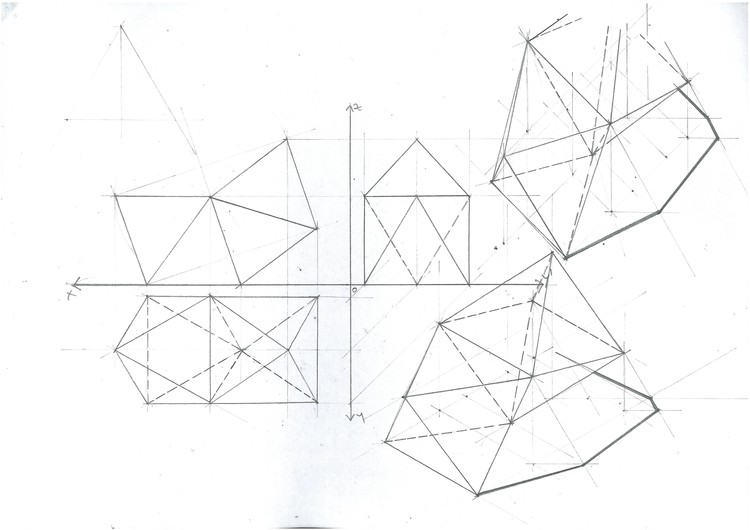
13. Know what a dodecahedron is and how to draw it in triple projection and axonometric.
At that place are several "simple" volumes out there that you need to know how to draw: the dodecahedron is the most approachable of the lot. Start with a triple projection, then axonometric.

14. Main triple projections.
A triple projection shows a volume from a frontal, tiptop and side view. If you've used any computer software, you already are familiar with these concepts from the front, top and side viewport. If you know how to depict the volume line by line, then you're much improve off.
15. Learn to solve 100 Descriptive Geometry Problems
You lot want to become smarter, more disciplined and faster in your thinking as an architect or designer? Try the '100 descriptive geometry problems' claiming and we'll talk later on that.

16. Learn to depict custom ellipses in all types of axonometric drawings.
Ellipses are notoriously hard to depict in a normal axonometrics, so drawing custom ones will help you get meliorate and ameliorate.

17. Develop a passion for solving whatsoever descriptive geometry trouble y'all come up beyond.
Most architects but run away from descriptive geometry (Don't believe me? Try asking 1 to draw a unproblematic dodecahedron sitting on its spatial diagonal). You need to do what everyone else isn't doing and go genuinely passionate about learning how to do it yourself.
Here's a free lesson I want you to endeavor out. It is on drawing a complex axonometric in multiple coordinate systems and volition probably melt your brain (information technology is the nigh hard lesson from my beginner form on architectural technical drawing).

18. Know how to depict all the standard primitives: cube, pyramid, cylinder, cone, tetrahedron etc.
Patently drawing them in triple project and different types of axonometrics is all-time. How practice you outset with that? Pick a standard cube with the length of 4 cm. Get depict a triple project and iii different axos of information technology.
19. Know how to draw all standard geometrical shapes: square, circle, pentagon, hexagon.
Get started with planar geometry. You lot volition use this later for facade and planar studies. Also, every bit a tip: knowing multiple types of geometry will assistance you get proportions right for all your designs.

twenty. Ink all your best drawings – whether they are sections, technical details, artistic axonometrics etc.
Inking drawings (tracing over them with a liner instead of just leaving them in standard pencil) is the best option out at that place for preserving them. How exercise yous employ these tips to get better results with your architectural drawing? To go started asap with technical drawing and get consistent results I recommend taking my course on technical drawing called 'Technical Drawing 101'. It will get you from being a consummate "noobie" with cipher spatial vision to being able to draw circuitous axonometrics, cast shadows and principal other architectural technical drawings.
Become 'Technical Cartoon 101' with 80% discount here.
Cite: Michael Neatu. "20 Technical Compages Drawing Tips" 21 February 2018. ArchDaily. Accessed . <https://world wide web.archdaily.com/889367/20-technical-architecture-drawing-tips> ISSN 0719-8884

Source: https://www.archdaily.com/889367/20-technical-architecture-drawing-tips
Posted by: hawkinsgail2001.blogspot.com
0 Response to "How To Draw An Architectural Building"
Post a Comment